
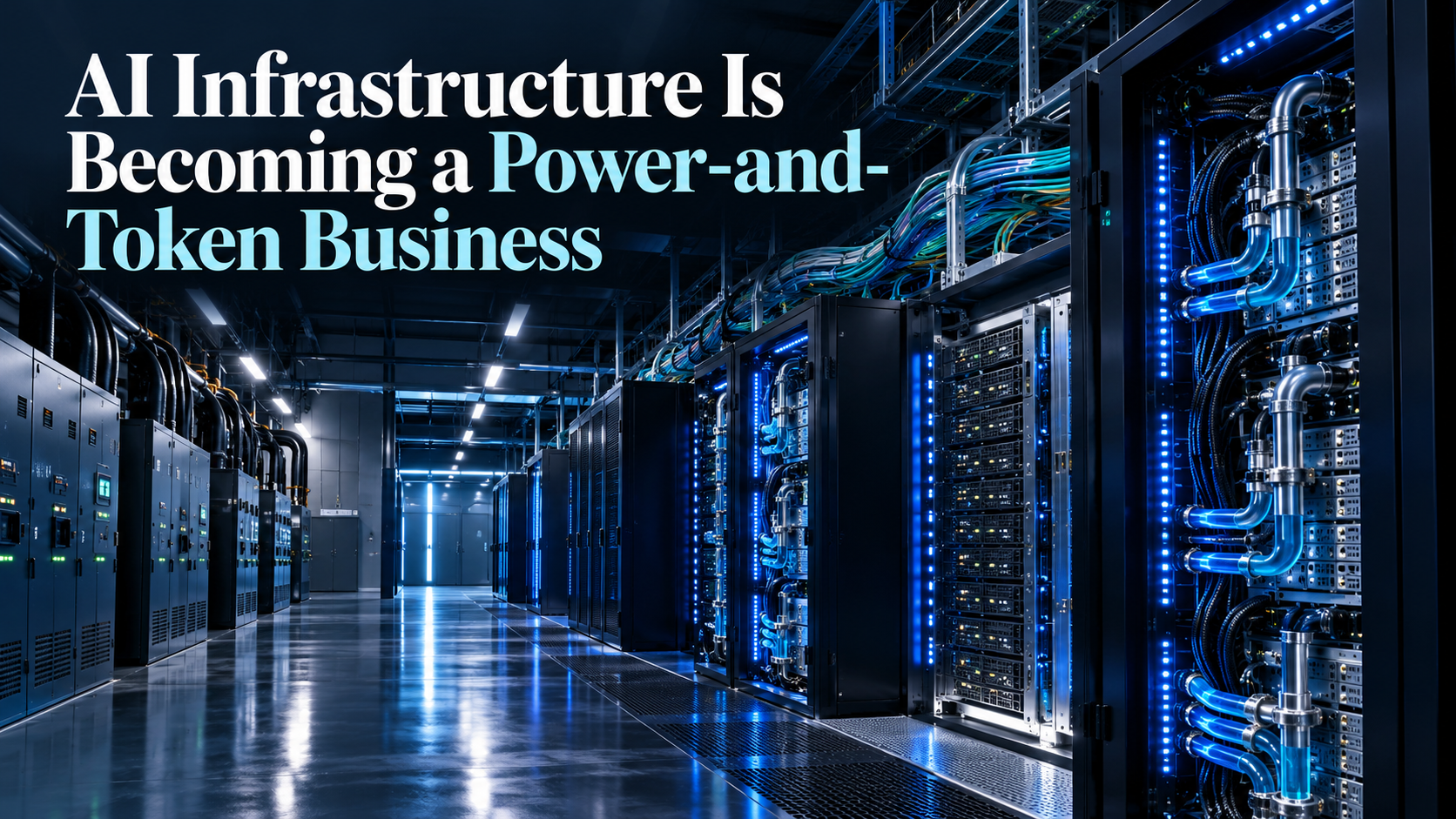
The most important change in AI infrastructure is not another accelerator announcement. It is the shift from buying compute as a product to securing compute as an operating capacity.
That shift changes the investment map, the competitive map, and the practical work of building an AI business. It moves the conversation from “Which chip is fastest?” to “Which system can reliably turn electricity, cooling, networking, and capital into tokens at an acceptable cost?”
The headline is no longer the GPU
For the last several years, the AI infrastructure story was organized around accelerators. That made sense when the scarce resource was access to training hardware. But the market has moved into a more operational phase. Customers are reserving inference capacity years ahead, operators are signing take-or-pay contracts, and the value of a site increasingly depends on whether it can move from grid connection to production tokens quickly.
QumulusAI’s September 2026 disclosure is a clean example. The company announced $240.9 million of new three-year take-or-pay agreements covering more than 2,000 NVIDIA Blackwell B300 GPUs. Both customers were repeat buyers, and their combined commitments exceeded $344 million. The important fact is not just the GPU count. It is that the hardware is being placed against signed demand rather than a forecast.
Source: QumulusAI contract reporting ↗
That structure turns compute into something closer to a contracted utility. It also creates a diligence question that should be asked of every neocloud: how much of the next deployment is already paid for, reserved, or tied to a customer with a history of renewing?
Power is becoming the first product
AI data centers are now large industrial projects. The bottleneck is often not whether a company can buy servers; it is whether the site can obtain power, cooling, fiber, permits, transformers, and a credible commissioning schedule. The next wave of infrastructure value will accrue to the operators who can compress that timeline.
Federal and local debates around data centers are increasingly about grid access, water, land use, jobs, and community impact. The public argument is changing because the physical footprint is changing. A data center is no longer invisible cloud infrastructure. It is a major load on a regional power system, a customer for construction trades, and a political question about who pays for capacity.
That is why “time to power” and “time to token” should be tracked as separate metrics. A campus may have a theoretical multi-hundred-megawatt path but still lack the substations, cooling loops, transmission upgrades, or operating staff required to turn that path into revenue.
Cooling is moving from component to architecture
Higher rack densities are pushing liquid cooling from an optional efficiency upgrade into a design constraint. Coolant distribution units, facility water loops, heat exchangers, pumps, controls, leak detection, and commissioning software now sit on the critical path.
Delta’s 2026 architecture makes the convergence visible. Its prefabricated AI modular data-center solution combines 800 VDC in-row power and 3 MW of liquid-cooling capacity in factory-tested infrastructure blocks, while its microgrid work links generation, storage, conversion, and intelligent control.
The opportunity is broader than any one vendor. The companies worth finding are often one or two layers below the headline system integrator: pumps, busbars, solid-state transformers, dielectric fluids, monitoring systems, and the field-service businesses that keep dense facilities operating.
Optics are the quiet constraint
When clusters grow, data must move between racks, rows, buildings, campuses, and regions. That creates a physical interconnect problem. Fiber, connectors, transceivers, lasers, optical packaging, and test capacity are becoming strategic inputs.
Corning and AT&T’s multi-year agreement valued at more than $3 billion is not an AI-only contract, but it is part of the same infrastructure supercycle. As AI increases data demand, fiber and cable become capacity that customers secure ahead of time.
For operators, optics belong in the same diligence packet as power and cooling. For suppliers, optical bottlenecks create a large discovery surface because many of the beneficiaries will not be household names.
Regional AI factories change the map
Firmus is an example of a regional operator turning distributed capacity into a strategic proposition. The company announced agreements with Meta covering contracted GPU capacity and expansion options at AI factories in Southeast Asia. Meta is already using NVIDIA GB300 NVL72 systems at Firmus’s Melbourne facility, and Firmus has described more than 900 MW of contracted capacity across its portfolio.
Source: Firmus and Meta announcement ↗
This model matters because the next customer may value speed, regional location, sovereign capacity, and an integrated power-and-cooling design more than it values a giant hyperscale campus. The best operators will combine site control with commercial discipline: secure demand first, then finance and phase the build.
AI is now operating AI infrastructure
As facilities get denser, software becomes necessary to keep the physical system legible. Aligned Data Centers’ deployment of Phaidra Prism shows where this is going: BMS, EPMS, mechanical, electrical, power, cooling, and IT data become one operating context for the people responsible for reliability.
This is not “AI software” in the generic sense. It is an operational layer for a machine that happens to be a data center. The best products will connect telemetry to decisions, explain anomalies, preserve institutional memory, and shorten the time between an alarm and a safe action.
What to track next
- Contract quality: disclosed terms, take-or-pay structure, prepayments, repeat customers, and source reliability.
- Commercial momentum: new commitments, expansions, anchor customers, and delivery milestones.
- Bottleneck exposure: power, cooling, optics, construction, network, and facility operations.
- Capacity expansion: actual MW/GW, credible paths, options, and commissioning evidence.
- Obscurity: under-covered operators and suppliers with real evidence of material participation.
Paxton’s role is to make these questions comparable. BOSSTOX can score the commercial quality of the signal. SCOUT can map sites, suppliers, power, and contracts. ATLAS and Fenway Web can turn facility data into an operating experience. Kingswell and KEYSTONE can find the less-obvious companies that win when the stack broadens.
The conclusion
The AI infrastructure market is becoming a power-and-token business. The winners will not be defined only by the speed of a chip. They will be defined by the ability to secure energy, cool the rack, move the data, finance the capacity, contract the customer, and operate the whole machine.
That is why the most valuable “picks and shovels” are increasingly systems, not parts. The next durable advantage will belong to the companies that shorten the distance between electricity and useful intelligence.
This article is analysis, not investment advice. Figures are linked to cited sources and undisclosed values are not inferred.
Leave a Reply